
so-called blind rib, for creating raised bands on the spines of book covers

PORTFOLIO

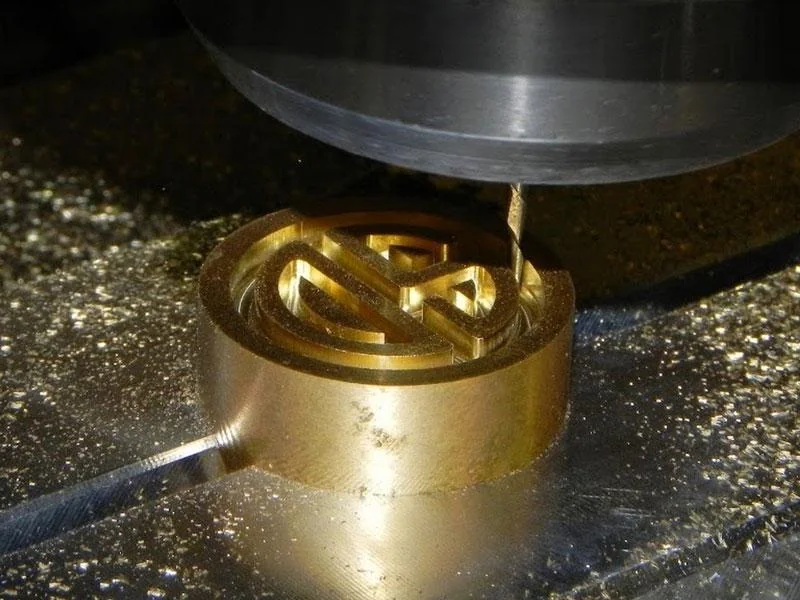
We manufacture aluminum-magnesium alloy and brass alloy dies using chemical etching and state-of-the-art CNC technology.

We do more than just produce printing dies: using our own clichés, we also perform foil stamping and embossing - for formats up to B/2.

We work specifically for printing companies and binderies, so we are well-versed in the technical requirements and possibilities of surface finishing.

Whether it involves a logo, delicate graphics, or complex typography, our goal is to ensure that both the finished printing plate and the resulting print are precise, distinctive, and of high quality.

Our company is a small family business with over three generations of experience in the production of metal dies and related surface finishing techniques - specifically hot foil stamping, embossing, and debossing. We offer a comprehensive, one-stop solution for both die-making and the printing process itself. Since our inception, our goal has been to provide our clients with fast, precise, and high-quality service, while keeping our prices as competitive as possible.
Furthermore, we are committed to meeting all requirements - from the smallest orders to the largest - by consistently delivering top-quality results with a quick turnaround.

1600+
SATISFIED CLIENTS
30+
YEARS OF EXPERIENCE
B/2
MAXIMUM SIZE
01 — CLICHÉ MAKING


02 — FOIL STAMPING / GILDING
03 — EMBOSSING


Have a question? Get in touch with us!
Write to us or give us a call. We are happy to help!

FEEDBACK

AAA
INFORMATION
I would like to have a printing plate made; in what format should I send my artwork?

- If speed is a priority, the simplest approach is to send your vector graphic via email. For instance, if we receive the vector file during the afternoon on a workday, it can be ready by early the following morning.
- The best format is a scaled, grayscale .pdf or .eps file.
What does it mean when they ask for vector graphics?
- Images or text in vector format are not composed of pixels—unlike image files with extensions such as .jpg or .tiff, which may suffer a loss in quality when resized.
- Vector files - such as .cdr files (CorelDRAW) or .ai files (Adobe Illustrator) - are resolution-independent; they can be scaled to any size without any change in quality. For this reason, we generally request files in these formats, or alternatively, a universal .pdf file exported from them.
- Important! To avoid any potential issues, please convert all text in your vector files into curves (in CorelDRAW, this can be done using the CTRL+Q shortcut).
What should we pay attention to when sending files?
- The technology has its physical limits. Only lines thicker than 0.15 mm can be produced reliably.
- Due to the nature of the technology, we require 100% black graphics. In other words, the areas intended to be the printing surface on the final plate must be solid black, while the non-printing areas must be solid white. It is not possible to produce a suitable tool from source files that use CMYK or RGB color, contain halftones (rasters), or are anything other than solid black. Please do not include any crop marks or registration marks, as these only hinder the film-making process.


